Amgix v1.3.2
Release of Amgix server v1.3.2 is now available.
Broker Metrics and Dashboard Tab
In this release we've added internal metrics to keep track of the most important broker (RabbitMQ) queue depths:
- search: queue of search requests
- documents: queue of async single-document ingestion requests (upsert and delete)
- documents-bulk: queue of async bulk document uploads
- collection-stats: queue for asynchronously updating collection's document stats
We've added a tab to the Home panel in the dashboard, where you can see live and historical trend metrics for these queues.
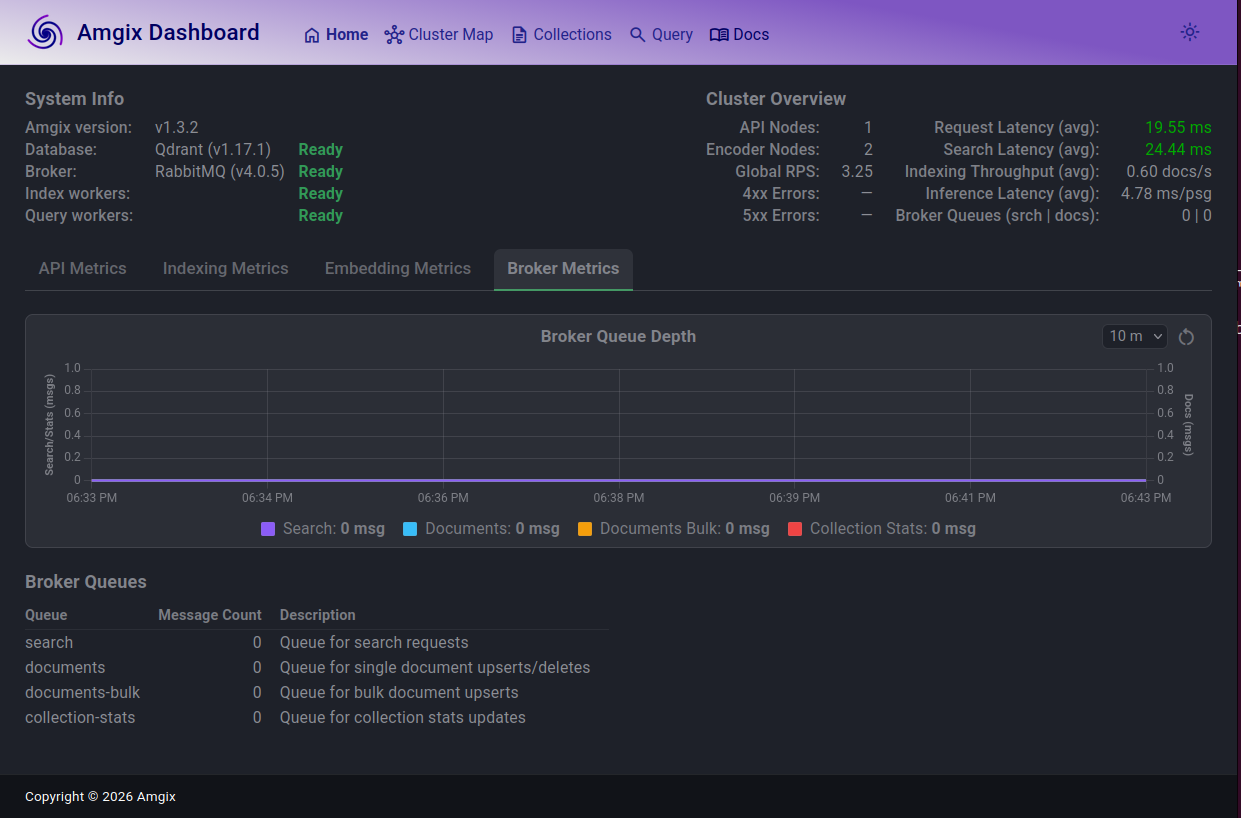
Healthy
The first screenshot is from Amgix-One instance running under a light load. All queues are empty - all the messages are getting processed as they arrive. This is a healthy cluster.
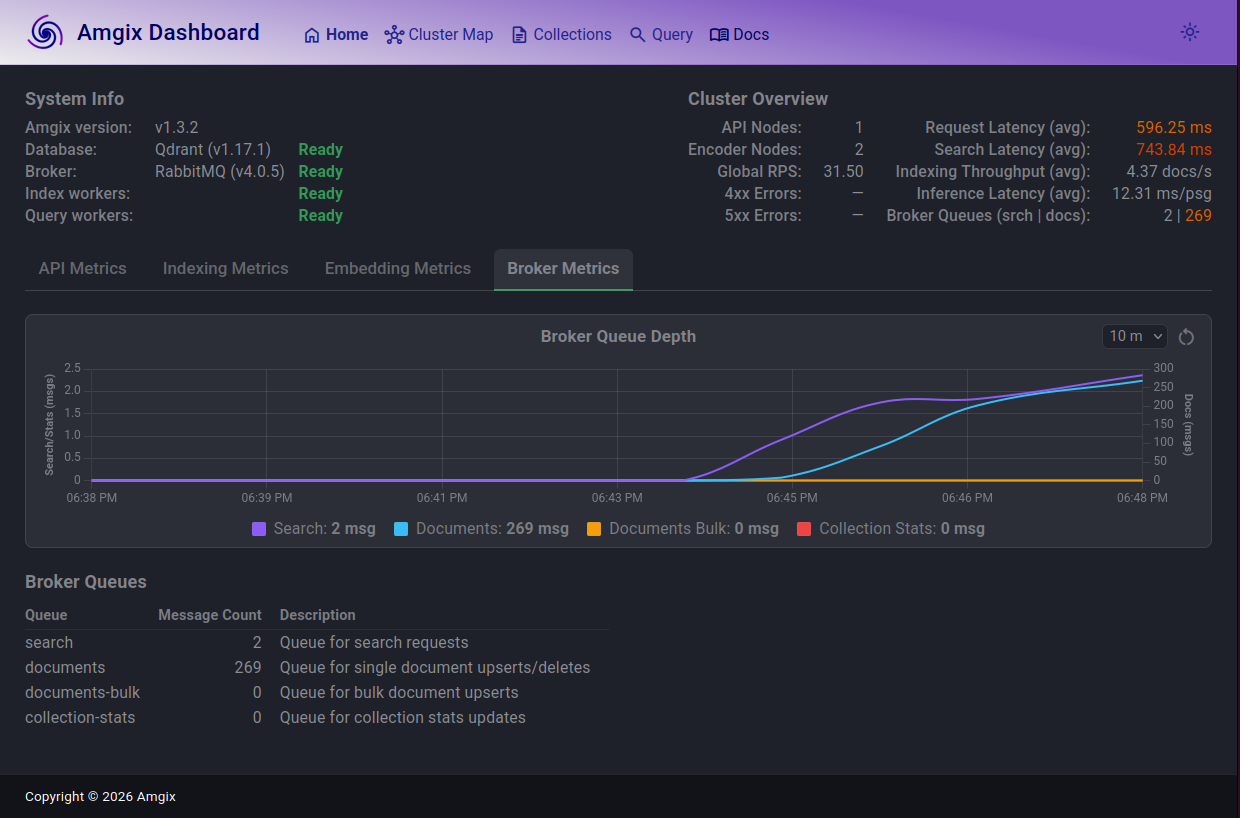
Overloaded
Here, the system is underprovisioned for the amount of load. Not only are request latencies getting worse, but search and document queues are growing. This cluster needs to be scaled up.
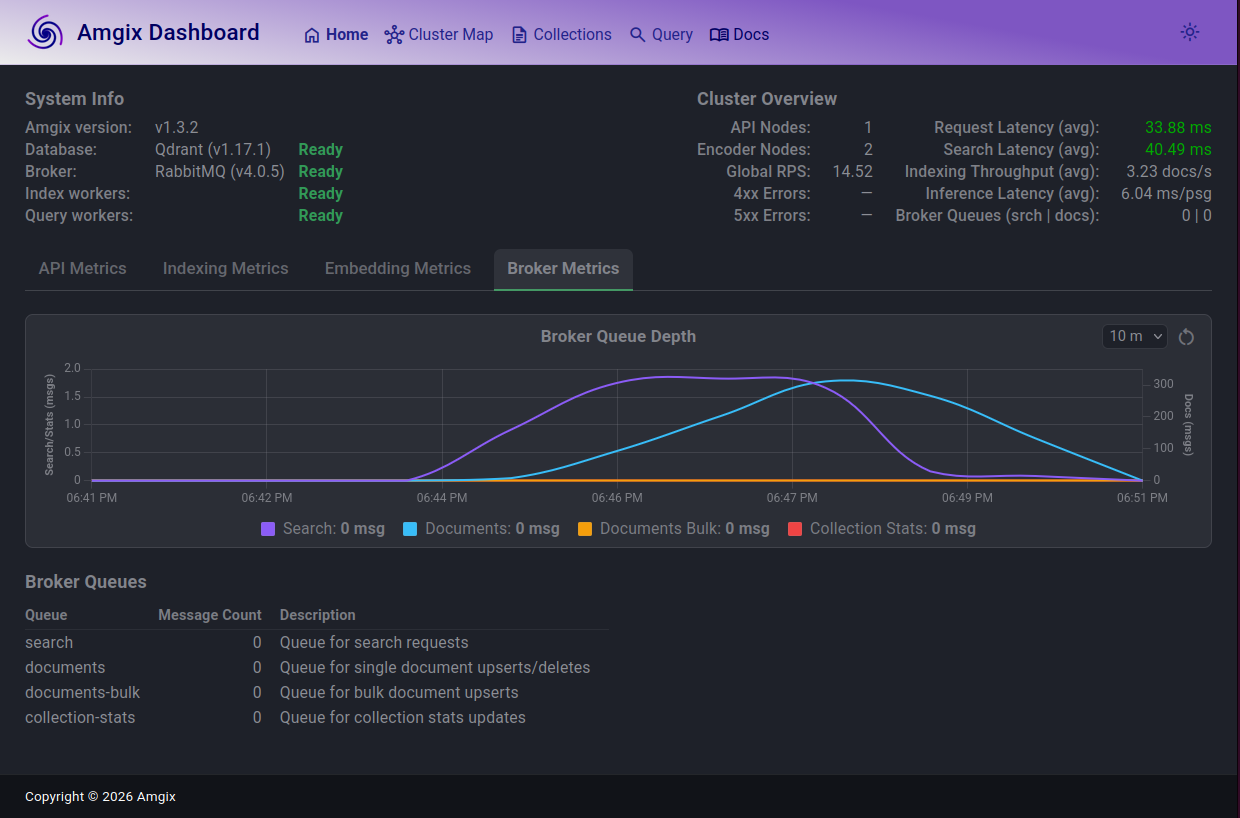
Recovered
We see how the system has recovered to the level of processing it can handle. Request latencies are back to normal, search and document queues are empty. And you can see the history of the entire event in the queue chart.
Note
These screenshots were taken from Amgix-One container running random embedding, ingestion, and hybrid-search (3 vectors) workloads on CPU, and limited to 4 CPU cores.
Amgix-One With External Databases and RabbitMQ
We've made some changes to Amgix-One to allow you to run it with an external Qdrant/PostgreSQL/MariaDB database, and an external instance of RabbitMQ. All you need to do is pass AMGIX_DATABASE_URL and/or AMGIX_AMQP_URL environment variables on startup of the container and Amgix-One will use those. If you specify one or both of these variables, internal instances of them will not be started (resulting in a lighter runtime). Example:
docker run -d \
    -v <path-to-data>:/data \
    -p 8234:8234 \
    -e AMGIX_DATABASE_URL=qdrant://my-qdrant:6334 \
    -e AMGIX_AMQP_URL=amqp://guest:guest@my-rabbit:5672 \
    amgixio/amgix-one:1